fairlearn.metrics.plot_roc_curve_by_group#
- fairlearn.metrics.plot_roc_curve_by_group(y_true, y_score, *, sensitive_features, ax=None, plot_overall=True, plot_chance_level=True, pos_label=None, title=None)[source]#
Plot ROC curves for a binary classifier disaggregated by sensitive feature.
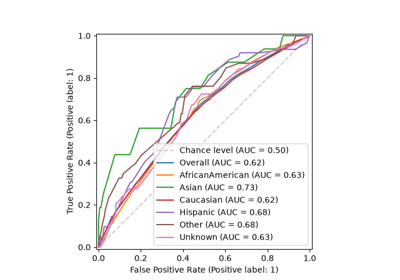
A separate Receiver Operating Characteristic (ROC) curve is drawn for each subgroup defined by
sensitive_features, together with the area under the curve (AUC) for that subgroup. Comparing the curves makes it easy to see whether the classifier separates the positive and negative classes equally well across groups: curves that lie on top of one another indicate similar ranking performance, whereas curves that diverge indicate that the model discriminates between the classes better for some groups than for others.When more than one sensitive feature is provided, the unique combinations of their values define the subgroups (for example
"Female,White"), following the same convention asMetricFrame. Sensitive features containing missing values are rejected with aValueError, consistent withMetricFrame.Added in version 0.15.0.
Changed in version 0.16.0: Missing sensitive feature values now raise a
ValueErrorinstead of being included in the overall curve but skipped in per-group curves.- Parameters:
y_true (array_like) – The ground-truth binary labels.
y_score (array_like) – Target scores for the positive class, such as probability estimates returned by
predict_proba(X)[:, 1]or the output ofdecision_function.sensitive_features (array_like,
dictof 1d arrays,pandas.DataFrame) – The sensitive feature(s) used to define the subgroups. At least one sensitive feature must be provided.ax (matplotlib.axes.Axes, optional) – The axes on which to draw. If not supplied, a new figure and axes are created.
plot_overall (bool, default=True) – Whether to also plot the ROC curve computed over the entire dataset for comparison.
plot_chance_level (bool, default=True) – Whether to plot the chance-level (no-skill) diagonal that a random classifier would produce.
pos_label (
int,float, bool orstr, optional) – The label of the positive class. WhenNone, the positive class is inferred by scikit-learn (1 when the labels are in{-1, 1}or{0, 1}).title (
str, optional) – The title to set on the axes, for example the name of the estimator.
- Return type:
- Returns:
The axes on which the curves were drawn.
- Raises:
ValueError – If
y_true,y_scoreandsensitive_featuresdo not have the same length, or ifsensitive_featurescontains missing values.RuntimeError – If matplotlib is not installed.
Notes
This function only produces the plot. To obtain the AUC scores programmatically, use
MetricFramedirectly, which is the idiomatic way to disaggregate any metric in Fairlearn:from sklearn.metrics import roc_auc_score from fairlearn.metrics import MetricFrame mf = MetricFrame( metrics=roc_auc_score, y_true=y_true, y_pred=y_score, sensitive_features=sensitive_features, ) mf.by_group # AUC per subgroup mf.overall # AUC over the whole dataset
Each subgroup must contain both classes for its ROC curve and AUC to be well defined. To further customize the appearance of the plot, pass an existing
matplotlib.axes.Axesviaaxor restyle the returned Axes.